Flood Response 2026 · Rasuwa & Trishuli Corridor
Standing with affected families from day one.
When catastrophic flooding struck Rasuwa and downstream communities, we mobilized immediately—launching a $25,000 relief initiative to deliver urgent shelter, clean water, food and medicine directly to survivors.
Our field teams are on the ground navigating blocked roads to reach isolated villages, ensuring supplies reach families who lost everything.
Behind every load is a ten-year record of direct delivery: 800 homes rebuilt after the 2015 earthquake, lifesaving oxygen during COVID, and verified receipts accounted for down to the single nail.
Verified action on the ground. See how relief moves from your hands to the front lines.
From the field
The first loads, and the roads they had to take
What has happened
These are not just numbers.
Every person missing or lost belongs to a family that is waiting, searching, and hoping.
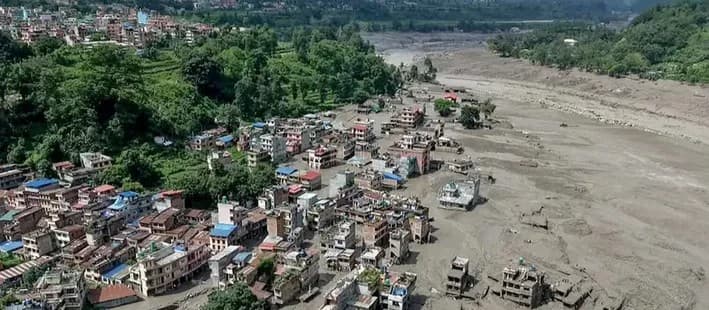
A devastating flood near the Nepal–Tibet border has caused severe destruction in Rasuwa and in communities downstream along the Bhote Koshi and Trishuli rivers. Roads and bridges have been washed away, homes have been destroyed, infrastructure has been badly damaged, and many families have lost loved ones, homes and livelihoods.
As rescue efforts continue, at least 95 people have been reported dead and hundreds more remain missing or out of contact. The situation is still developing, and the true extent of the damage may not be known for some time.
- Rasuwa
- Syaphru Besi
- Timure
- Langtang
- Trishuli corridor
- Bhote Koshi
What survivors need right now
Your gift is converted into these essentials, on the ground, fast.
- Food and clean drinking water
- Blankets, clothing and basic household supplies
- Tarpaulins and temporary shelter
- Hygiene and sanitation materials
- Medicine and first-aid supplies
- Transport of relief materials to hard-to-reach areas
- Support for families who have lost their homes and livelihoods
- Longer-term rebuilding and recovery
Proven track record · 10 years of impact
10 years of showing up and accounting for every rupee.
We don’t ask you to take our word for it. From the 2015 earthquake to COVID-19 oxygen plants and school rebuilding, here is what our volunteers have delivered.
800
Transition homes built and handed over
6,100
People given a month of food in the first weeks
10
Oxygen plants delivered to Hospitals
$2M+
Raised and delivered since 2015
10,000+
Expert hours given by board members and volunteers
Minimal
Administrative cost taken from donations
“Rajdhani Mandir, located in Northern Virginia, acted promptly after the earthquake news and its congregation donated wholeheartedly, including Mandir organizing several earthquake victims relief fundraisers in Mandir and outside. Mandir was looking to pick an appropriate organization in Nepal, India and/or local to disburse the funds. Although without much history, Mandir reluctantly sponsored 30 houses through MRN. However, Mandir management became pleasantly surprised when MRN provided such detailed proof of how the funds were used, including the material cost up to a single nail or brick, names, records and pictures of the recipients of Mandir sponsored houses, and audit trails showing that MRN is truly a zero overhead NGO. Mandir decided to sponsor another enhanced design 12 houses with shade for the livestock. It has been a pleasure to work with and support such dedicated volunteers and their NGO, the MRN.”
Live from the ground
Latest updates from Facebook
The fastest and most human view of the work, straight from our page as it happens.
For children affected by the Rasuwa floods, the journey back to normal life begins with a chance to learn again. When disaster strikes, children lose more than homes and classrooms. Their routines, sense of safety, friendships, and opportunities to learn and grow can all be disrupted. And while the immediate emergency may pass, rebuilding that sense of normalcy takes time, care, and sustained…
Read on Facebook(opens in a new tab)
Read on Facebook(opens in a new tab)
Every contribution carries hope.
A heartfelt thank you to our 194 individual donors who have come together to support families affected by the devastating flash floods in Nepal. Together, your generosity has helped raise $190,000 toward relief, recovery, and rebuilding efforts. Every dollar makes a meaningful difference in the lives of flood survivors. Your compassion is helping communities move forward with strength and…
Read on Facebook(opens in a new tab)
The response is moving faster than this page can be rewritten. Photographs, distributions and news from the corridor are posted to our Facebook page as they happen, and the figures here are reconciled afterwards.
Donate
Choose where you want to make an impact
Double your gift through matched funding. Every donation is matched dollar-for-dollar, up to $25,000.
Double Your Impact
Every gift matched dollar-for-dollar, up to $25,000.
$1,650 raised · 27 Oct 2026
Double my gift
Not sure where your gift is needed most? Donate to the Flood Response Fund, and Mission Rebuild Nepal directs it to the highest-priority need.
Donate to Flood Response FundGive now
Turn a gift into relief on the ground

This appeal stays open, every gift beyond Phase 1 funds long-term rebuilding.
Field updates
Follow the work, and the money
Updates from Rasuwa as relief reaches each community, with photographs and receipts.
This opens a pre-filled message in your own email application. Nothing is stored here.