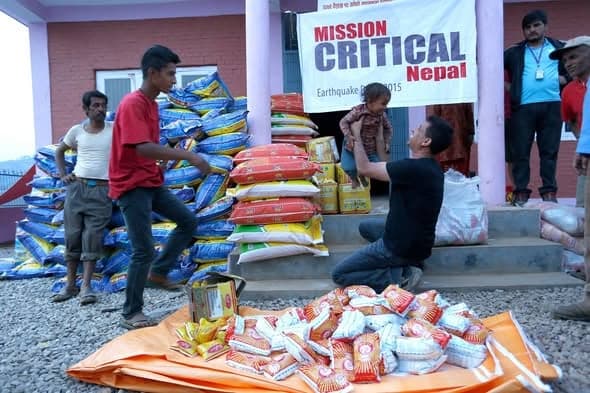
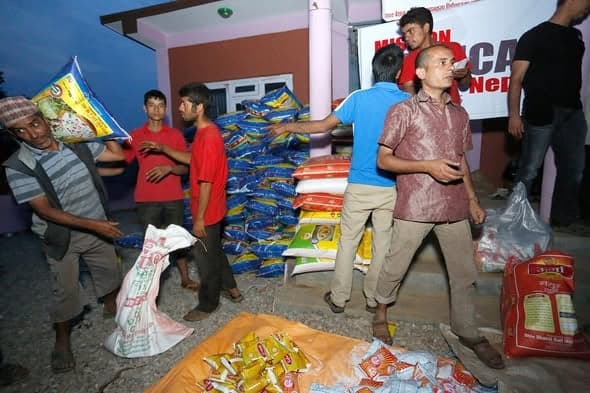
Relief supplies being sorted under the Mission Critical Nepal banner. Posted 11 May 2015, the day before the second earthquake.2015-05-11 · Mission Rebuild Nepal
Summary
Mission Critical Nepal was the emergency operation that Mission Rebuild Nepal's founders ran in the weeks after the 25 April 2015 earthquake, four months before the organisation was formally constituted. Mobile medical camps in Sindhupalchowk treated 250 patients. Four village development committees in Sindhupalchowk and Dhading received a month of food reserves for 6,100 people. Fifteen hundred tents were distributed, and Sipapokhare was declared a no-hunger zone once every household in the VDC had been reached. The team was in Bhotang, on the Tibetan border, when the 12 May aftershock struck.
Worked with
Team Karma
Nepal Education and Cultural Center (NECC)
America Nepal Helping Society (ANHS)
America Nepal Medical Foundation (ANMF)
Figures
What this project recorded
Each figure is drawn from the organisation's own records. The documents behind them are released on request.
250
Patients treated
At mobile medical camps set up across Sindhupalchowk.
6,100
People given a month of food
Across four VDCs in Sindhupalchowk and Dhading districts.
1,500
Tents distributed
100%
Of Sipapokhare reached
The VDC was declared a no-hunger zone once relief packages had reached every household.
US$23,000
Raised in the first three weeks
Of which US$9,900 had already been transferred to the field team by 14 May 2015.
On 25 April 2015 a magnitude 7.8 earthquake struck central Nepal. Sindhupalchowk, north-east of Kathmandu, lost more people than any other district. Mission Rebuild Nepal's founders were on the ground there on the fourth day, working under the name Mission Critical Nepal. The organisation itself would not be registered for another two months.
The quake was followed by more than 250 aftershocks, the largest a 7.3 on 12 May with its epicentre close to Sindhupalchowk. Over 8,500 people were killed nationally, 22,000 injured, and roughly half a million homes destroyed. In the mountains the problem was not only the scale of the damage but the difficulty of reaching it: villages perched on hillsides, few motorable roads, and landslides closing what roads there were.
The response was assembled out of whoever could get there. Most of the people who would later sit on MRN's board were physicians, and they went first as physicians. Where the medical need thinned out, the work turned to food, tarpaulins and tents, which is not what any of them had trained for.
Assigning responsibilities in Kathmandu: government facilitation, logistics, local support, medical, finance, media. Photographed May 2015.2015-05-20 · Mission Rebuild Nepal
Three doctors met in transit
Dr Baroon Rai, an intensive care physician in California, took unpaid leave from his ICU, raised about US$20,000 from his own hospital along with supplies, and flew out. Dr Sandesh Pandit, an orthopaedic and sports surgeon from Oregon, left four days after the first earthquake carrying supplies worth US$30,000. Dr Madan Uprety, a psychiatrist in Virginia, was travelling the same route. The three met in transit and used the flights to work out what they would do on arrival.
“After hearing news of massive earthquake, Baroon didn't think twice to take time off without pay from ICU, he raised about $20K from his own hospital and supplies and boarded on the way to Ground zero.”
In Nepal they joined people already working. Dr Navin K Sharma handled logistics and supply chain out of Kathmandu. Dr Arun Kunwar, a paediatric psychiatrist at Kanti Hospital, and the cardiac surgeon Dr Bhagawan Koirala took on monitoring roles. Padam Regmi and Sagar Kandel of the America Nepal Helping Society had travelled out immediately after the earthquake and were distributing food and relief materials in Sipapokhare. Dr Rashmi Thapa, Dr Ganesh Chaudhary, Dr Binod Dhungana and Dr Dinesh Subedi were met in the field.
US$20,000
Raised by Dr Baroon Rai
From his own hospital, alongside donated supplies.
US$30,000
Of supplies carried from Oregon
Brought into Nepal by Dr Sandesh Pandit.
US$9,900
Transferred to the field by 14 May
Raised through the Nepal Education and Cultural Center in Washington DC.
What the operation delivered
01Mobile medical camps set up across Sindhupalchowk. 250 patients treated.
02Food distribution sufficient for one month's reserve for 6,100 individuals across four VDCs in Sindhupalchowk and Dhading districts.
031,500 tents distributed.
04Sipapokhare VDC declared a no-hunger zone after relief packages reached 100 per cent of the population.
05A trek to Bhotang with four doctors, nurses, a physician assistant and a logistics and support team, carrying relief packages and fly-control measures.
A distribution running into the evening. Sindhupalchowk, May 2015.2015-05-11 · Mission Rebuild Nepal
Locations were chosen on need rather than convenience. The team went where nobody else had yet reached: Jeevanpur in Dhading, Melamchi and Nawalpur in Sindhupalchowk, Syaule with a group of non-resident Nepalis from the UK, and Bhotang in the far north of Sindhupalchowk on the Tibetan border. Bhotang meant a six-hour drive from Kathmandu followed by a four-hour trek.
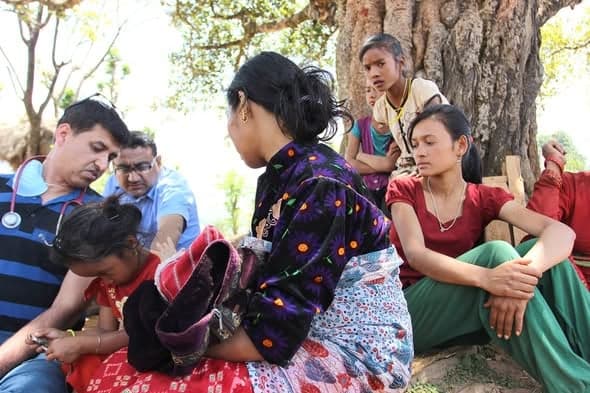
A mobile medical camp working in the open. Sindhupalchowk, May 2015.2015-05-11 · Mission Rebuild Nepal
12 May, in Bhotang
The Bhotang team had been flown into the isolated upper valley the previous night by the Nepalese Army. They were handing out relief packages when the 7.3 aftershock hit. Two trucks carrying their supplies were stranded on the road behind them, cut off by a landslide that closed the access route in both directions.
“We were distributing relief package in one of the worst geographical locations when earth quake struck again. Our team reached the isolated area via helicopter with the help of Nepalese Army previous night. Within a minute of earthquake, we changed our mission from relief to Emergency medical care.”
Elsewhere on the mountain that day, Dr Dikshanta Prasai and Yuvraj Sharma were nearly killed. Two volunteers, Vera Leader and Nepo Lina, fell acutely ill and had to be evacuated from the work zone. The helicopter that had carried the team into Bhotang crashed fatally about a week after the operation there ended.
From Mission Critical to Mission Rebuild
By early May it was clear that relief was the shorter half of the problem. At a meeting of volunteers and local leaders in Kathmandu on 2 May, Sipapokhare VDC in southern Sindhupalchowk was chosen as the place to concentrate longer-term work: local activists could be mobilised there, around half the villagers came from indigenous communities, and a cluster of houses hosting a wedding had collapsed in the VDC, killing more than five dozen residents and guests. On 22 May the operation announced that it was transitioning from Mission Critical to Mission Rebuild. The organisation was registered in Virginia and with the Government of Nepal, and its 501(c)(3) application was approved on 30 June 2015.
2015-04-25
A magnitude 7.8 earthquake strikes central Nepal. Sindhupalchowk is the worst-affected district.
2015-04
Fourth day after the earthquake. The founding members begin relief work in Sindhupalchowk under the name Mission Critical Nepal, before the organisation exists on paper.
2015-05-02
At a meeting in Kathmandu, Sipapokhare VDC is selected for sustained work.
2015-05-07
Reported to date: 250 patients treated, a month of food for 6,100 people across four VDCs, 1,500 tents distributed, and Sipapokhare at full relief coverage.
2015-05-11
A team leaves for Bhotang on the Tibetan border with four doctors, nurses and a physician assistant, relief supplies and fly-control measures.
2015-05-12
A magnitude 7.3 aftershock. The Bhotang team switches from relief to emergency medical care; two supply trucks are stranded by landslides.
2015-05-14
About US$23,000 raised for Mission Critical Nepal, US$9,900 of it already transferred to the field.
2015-05-22
Mission Critical becomes Mission Rebuild.
2015-06-30
The 501(c)(3) application is approved.
Cross-checked
The same project in the impact index
These are the figures the organisation holds for this project across its whole record, each with the source it rests on. Where the archive disagreed with itself, the discrepancy is stated rather than resolved quietly.
4 days
From the earthquake to the first team on the ground
Board members were working in remote Sindhupalchowk on 12 May 2015, when the second major earthquake struck. The organisation was not yet formally registered.
6,100
Individuals given a month of food reserve
Distributed across four VDCs in Sindhupalchowk and Dhading districts.
1,500
Tents distributed
250
Patients seen at mobile medical camps
Camps set up in Sindhupalchowk in the first fortnight.
100%
Of Sipapokhare's population reached with a relief package
The VDC was declared a no hunger zone once coverage was complete.
5 photographs
From the field
Photographs published by the organisation while the work was going on, with the dates they were posted.
Sindhupalchowk, May 2015.2015-05-11 · Mission Rebuild Nepal
Staging food for distribution.2015-05-11 · Mission Rebuild Nepal
Screening survivors where their house used to stand.2015-05-20 · Mission Rebuild Nepal
What was left of a hillside house.2015-05-20 · Mission Rebuild Nepal
A householder on the remains of his home.2015-05-20 · Mission Rebuild Nepal
Mission Rebuild Nepal's founders were distributing relief in a remote corner of Sindhupalchowk when the second major earthquake struck on 12 May 2015. Within a minute they had switched from handing out food to emergency medicine.
The first public account of the relief operation, published two weeks after the earthquake, lists what had been done in four village development committees across two districts.
Mission Rebuild Nepal is a 501(c)(3) non-profit organization registered in the state of Virginia. Money leaves the United States in stages and each stage is released against receipts for the last one.