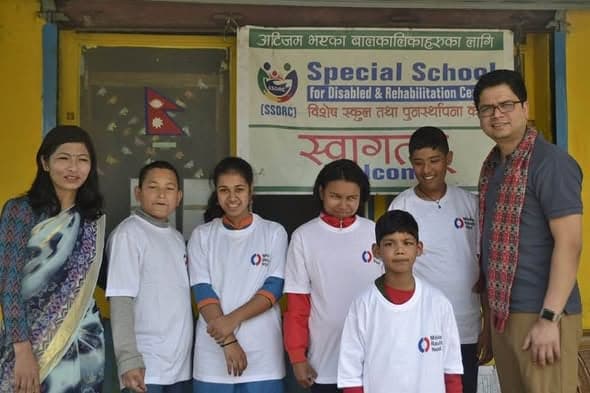
Students, staff and MRN's secretary Ashok Oli at SSDRC, Old Sinamangal, during his visit on 3 April 2019.2019-04-07
Summary
The Special School for Disabled and Rehabilitation Center takes children with autism and other disabilities, charges no school fees, and had 45 pupils against a waiting list of 400 when Mission Rebuild Nepal chose it as its 2019 cause. MRN set out to fund nine classrooms, a toilet block and a canteen, at a target of $60,000, releasing money in instalments against proof of completed work. Two transfers totalling NPR 2,047,372 are documented in the school's building fund receipts, in February 2020 and April 2021.
Worked with
Special School for Disabled and Rehabilitation Center (SSDRC)
Special Needs a Chance, Virginia Commonwealth University
Figures
What this project recorded
Each figure is drawn from the organisation's own records. The documents behind them are released on request.
45
Children enrolled
Taught and supported by 26 teachers and staff
400
Children on the waiting list
The current building cannot hold more than 45
100
Children rehabilitated into society
30 placed in inclusive classes in mainstream schools; 4 trained vocationally and now employed by SSDRC
$60,000
Construction target
Nine classrooms, one toilet block and a canteen
NPR 2,047,372
Released to the building fund by April 2021
NPR 1,011,369 on 23 February 2020 and NPR 1,036,003.50 on 16 April 2021
14
Awards to SSDRC
10 national and 4 international
A school that charges nothing, holds 45 children and has 400 more waiting is not short of demand. It is short of rooms. Mission Rebuild Nepal chose the Special School for Disabled and Rehabilitation Center as its 2019 cause and set out to fund the building it needs.
Why autism, and why in Nepal
The Centers for Disease Control put the prevalence of autism spectrum disorder at 1 in 59 children. ASD begins in childhood and usually persists into adolescence and adulthood, and in most cases it is apparent within the first five years of life. It affects social behaviour, communication and language to varying degrees, and narrows the range of a child's interests and activities. Intellectual functioning varies enormously across the spectrum, from profound impairment to superior levels.
There is no official data on how many children in Nepal are autistic, or how many of them are out of school. What reports there are suggest that diagnosis is largely confined to children with severe autism, which means children with higher intellectual functioning rarely come to anyone's attention outside their own family.
“community people don't understand exactly about autism ... they don't know about it, so they think negatively about autistic children, saying our child is crazy”
To avoid the shame the community imposes on them, parents often lock their children inside the house. Children with ASD in Nepal are frequently denied the right to attend school at all, in part because parents and professionals alike know so little about the condition. Where services and support are inadequate, the emotional and financial burden of care falls entirely on the family.
The school
SSDRC began in Kathmandu in 2010 with two children Sabita Upreti found on the street, and the money her family had saved for her own future. Mission Rebuild Nepal has described it as the only school in Nepal for children with autism. It charges no school fees. It runs on individual donations, in-kind contributions and the income from a small micro-enterprise shop at the school.
Organisation
Special School for Disabled and Rehabilitation Center (SSDRC), ssdrc.org.np
Location
Old Sinamangal (Pepsicola), Kathmandu-32
Founded
2010, with two children taken in off the street
Registration
District Administration Office no. 850/2068, affiliated to the Social Welfare Council under no. 34534
Status
Non-governmental and non-profit, and income-tax exempt under clause 2(s) of the Income Tax Act 2058
Fees
None
Catchment
Children travel in from Kathmandu, Lalitpur, Bhaktapur and other parts of Nepal. All 45 need transport to and from school.
—45 children and 26 staff as of March 2019, with 400 children on the waiting list.
—100 children already rehabilitated into society.
—30 children placed in an inclusive setup in a regular school.
—4 children trained vocationally, now working at SSDRC as job holders.
—10 national and 4 international awards.
Sabita Upreti
“I moved to Kathmandu from a rural village called Dolakha in the pursuit of a better life for myself. I was faced with great difficulties and challenges in my life despite being educated and perfectly capable of carrying out daily activities. When I saw an autistic child struggle for life on the street, I realized that my struggle was nothing compared to all the underprivileged children with special needs. That day, I made a promise to myself that I am going to do something about it. I don't have any children of my own but I feel like a mother, mother of such a big family. Their laughs, their cries, their hugs give me strength to fight against all odds. I will continue to be beside them no matter what difficulty I may face.”
Eight years after she started, she had a registered organisation with 26 employees, some of whom had themselves been rehabilitated at the centre before being hired by it. Her awareness campaign has reached well beyond the families of her own pupils, and Mission Rebuild Nepal credits it with pushing Nepal to recognise autism as a disorder in 2017. Her stated ambition is a larger autism treatment centre that can take many more children and serve as a research centre for the country.
How SSDRC teaches
—The work centres on daily living activities and on cognitive, behavioural and physical therapies, so that children become as independent as they can be.
—Children move through four levels, from D at the lowest to A, which is the level of rehabilitation.
—After level A a child goes on to a regular school or to vocational training.
—Orientation classes prepare the children who are moving into regular schools.
What Mission Rebuild Nepal is funding
Mission Rebuild Nepal works to four pillars of success: education quality, health service quality, infrastructure, and culture. SSDRC sits squarely under the first. The organisation had a demonstrated record, a leader with a track record of finishing what she started, and one specific constraint that money could actually lift: 400 children were waiting for places in a building that holds 45. Expanding the building is the whole of the problem, so expanding the building is the whole of the project.
The target was $60,000, covering nine classrooms, one toilet block and one canteen, marked on the master design of the school as the blocks Mission Rebuild Nepal would pay for. The materials specified for that work were prefabricated. Every dollar raised, less the transaction processing fee, went to the construction.
Two transfers are documented in SSDRC's own building fund receipts. Receipt 154, dated 23 February 2020, records NPR 1,011,369 from Mission Rebuild Nepal USA for autism school building construction. Receipt 036, dated 16 April 2021, records NPR 1,036,003.50 for the same purpose. The second followed a board vote on 27 March 2021 to release a further NPR 1 million on the strength of the progress SSDRC had made on the building.
The new block under construction, with a ramp at the entrance, April 2021.2021-04-16
A classroom interior, ceiling and lighting in place, April 2021.2021-04-16
A session at SSDRC, April 2019.2019-04-07
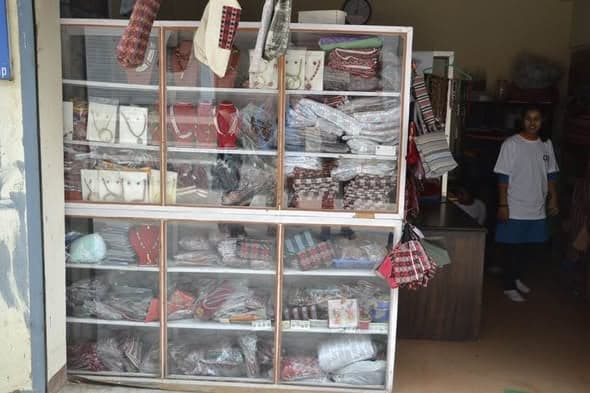
The micro-enterprise shop at the school, one of SSDRC's three sources of income.2019-04-07
The construction photographs above are the most recent record the archive holds, from April 2021. The classroom block was standing, rendered, ceilinged and fitted with a ramp at the door. Mission Rebuild Nepal has since confirmed the project complete.
Cross-checked
The same project in the impact index
These are the figures the organisation holds for this project across its whole record, each with the source it rests on. Where the archive disagreed with itself, the discrepancy is stated rather than resolved quietly.
45
Children enrolled at SSDRC
More than 400 more are on the waiting list. The current building cannot take them.
100
Children rehabilitated into society by SSDRC
A further 30 are in inclusive placements in mainstream schools, and four completed vocational training and now work at the school.
26
Teachers and staff
Some of them former students rehabilitated at the centre. The school charges no fees.
$60,000
Construction target
Nine classrooms, a toilet block and a canteen, built in prefabricated materials on SSDRC's own land.
NPR 1,000,000
Second instalment released to SSDRC
Voted by the board in March 2021 after reviewing progress on the building, under a memorandum that releases funds phase by phase.
On this project
In their own words
“I moved to Kathmandu from a rural village called Dolakha in the pursuit of a better life for myself. I was faced with great difficulties and challenges in my life despite being educated and perfectly capable of carrying out daily activities. When I saw an autistic child struggle for life on the street, I realized that my struggle was nothing compared to all the underprivileged children with special needs. That day, I made a promise to myself that I am going to do something about it. I don't have any children of my own but I feel like a mother, mother of such a big family. Their laughs, their cries, their hugs give me strength to fight against all odds. I will continue to be beside them no matter what difficulty I may face.”
Field updates
Written while it was happening
The organisation posted as the work went on. These are the most recent updates filed against this project.
Mission Rebuild Nepal disburses its funding to SSDRC in stages, each one released only against evidence that the last stage was built. In March 2021 the board voted to release the next instalment.
Mission Rebuild Nepal ended 2019 with the shortest appeal it ever wrote: one sentence over a short film, asking donors who cared about women's empowerment and access to education to remember it.
A benefit dinner at a Salt Lake City arts warehouse on 27 July 2019 split its proceeds between the construction of Nepal's only autism school and Sheroes Hangout, which employs survivors of acid attacks.
Mission Rebuild Nepal is a 501(c)(3) non-profit organization registered in the state of Virginia. Money leaves the United States in stages and each stage is released against receipts for the last one.